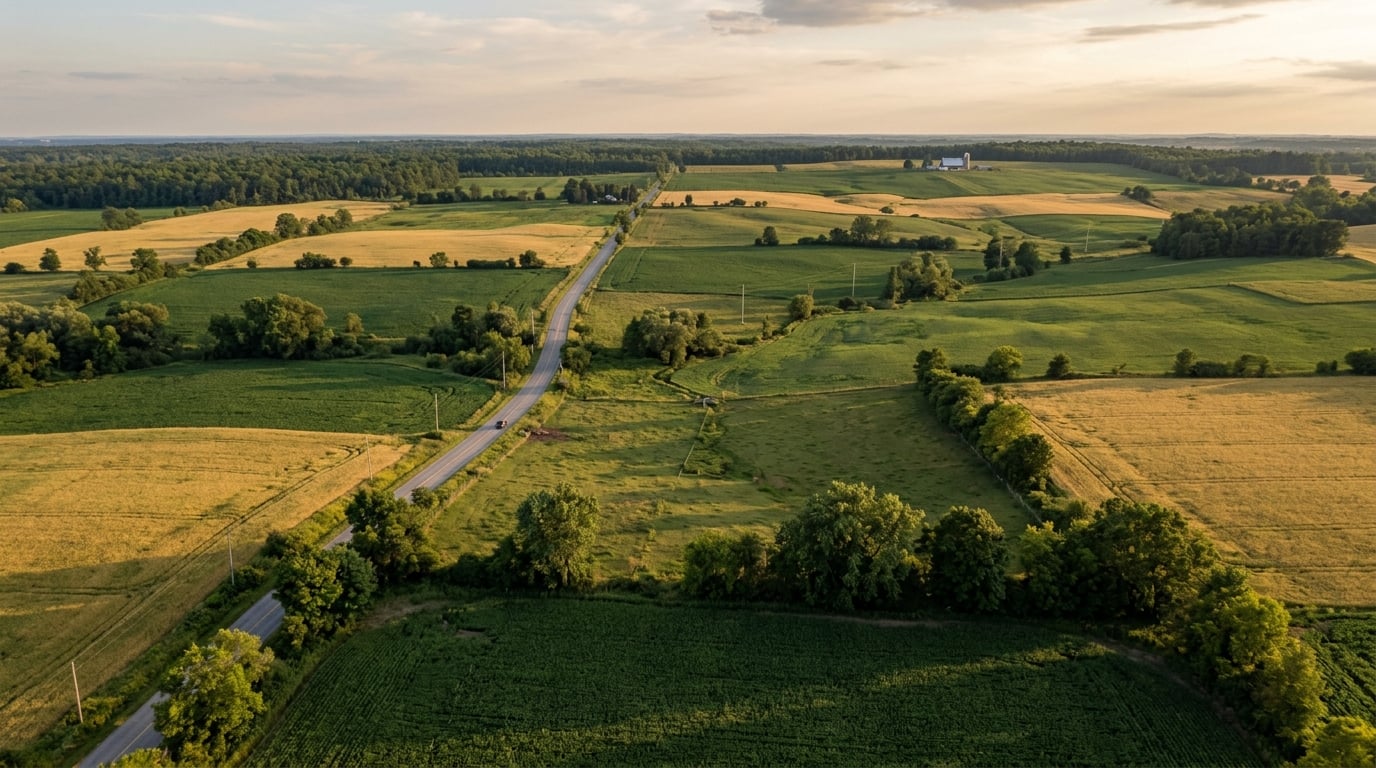
Buying land is one of the most misunderstood corners of the real estate market. A house comes with walls, a roof and an inspection report; a parcel of land comes with questions. Can you build on it? Is there a road to it? Where will the water and septic go? For buyers who do the homework, though, land can be the most rewarding purchase of all, a place to build a custom home, a long-term investment, or simply a quiet stretch of countryside to call your own.
This guide walks through everything a first-time land buyer needs to know: the different types of land for sale, where the best opportunities sit in Ontario and across Canada, what parcels actually cost in 2026, and the step-by-step process of buying without falling into the usual traps. Throughout, you can browse live vacant land listings pulled straight from the MLS®.
Why buying land is different from buying a home
When you buy a finished home, most of the big questions have already been answered. With land, you are buying potential, and potential has to be verified. Two lots that look identical from the road can be worlds apart once you factor in zoning, servicing and access. One might be ready for a building permit; the other might be locked behind a conservation designation that rules out construction entirely.
That is why land purchasing rewards patience and due diligence. The upside is real: you control the design of whatever gets built, you often pay less per square foot than for developed property, and well-chosen land in the path of growth has historically appreciated strongly. But the risks are just as real, which is why understanding the fundamentals before you make an offer matters more here than in almost any other real estate transaction.
Where the land market stands in 2026
After the interest-rate turbulence of the past few years, the 2026 land market has settled into a more rational rhythm. Higher borrowing costs cooled the frenzied lot-buying of the early decade, and that has worked in buyers’ favour: there is more inventory to choose from and more room to negotiate than at any point since 2021. Vacant land tends to sit on the market longer than housing, so motivated sellers are often open to sensible offers.
Demand has not disappeared, it has shifted. Buyers priced out of detached homes in the core are looking farther afield for buildable lots, and the appetite for recreational and rural acreage that surged during the remote-work era remains healthy. The result is a market with genuine opportunity for buyers who know what they are looking for.
Types of land for sale
“Land” is a broad label. Before you start searching, it helps to know which category you are actually shopping in, because each comes with its own rules, financing and price behaviour.
Residential land
Residential land is zoned for housing, anything from a single infill lot in an established neighbourhood to a serviced building lot in a new subdivision. This is the most common starting point for buyers who want to build a custom home. The key advantage is that the intended use is already permitted; the key thing to confirm is whether the lot is serviced (connected to municipal water, sewer and hydro) or whether you will need a well and septic system.
Commercial land
Commercial land is zoned for business use, retail, office, industrial or mixed-use development. It trades on different metrics than residential land, driven by traffic counts, visibility and permitted density rather than school districts or curb appeal. If your interest is commercial or industrial development, our sister platform WarehouseIndex focuses specifically on commercial and industrial property across the region.
Agricultural land and farms
Agricultural land is used for farming, and in Ontario much of it is protected by provincial policy that limits how it can be subdivided or developed. Farms often come with existing structures, barns, outbuildings, sometimes a farmhouse, and can qualify for farm financing and tax treatment. Buyers drawn to a rural lifestyle, hobby farming, or agricultural investment should look here. You can browse active farms and acreage for sale directly on the MLS®.
Vacant land parcels
Vacant land is exactly what it sounds like: undeveloped ground with no structures. It is the purest form of “potential” purchase and the largest category on the market by far. Vacant parcels range from quarter-acre building lots to sprawling hundred-acre tracts, and prices swing accordingly. This is where the phrase “vacant land for sale near me” usually leads, buyers hunting for a blank canvas within driving distance of home.
Live vacant land listings across Ontario
Active MLS® vacant land parcels, updated continuously. Click any listing for full details.
Location spotlight: Ontario
Ontario is one of the deepest land markets in the country, and it is where our live listings are concentrated. From commuter-belt building lots on the edge of the Greater Toronto Area to recreational acreage in cottage country, the province offers land at almost every price point.
Real estate land for sale in Ontario
The Ontario land market spans a huge range. Close to Toronto, buildable residential lots are scarce and command a premium, particularly in fast-growing communities such as Caledon and the northern reaches of Vaughan and Richmond Hill. Head an hour or two out and the picture changes completely: larger parcels, lower per-acre pricing, and far more choice.
Popular areas for land buyers
A handful of regions consistently draw the most land buyers in Ontario. Cottage-country markets such as Kawartha Lakes, Huntsville and the wider Muskoka area and the Bruce Peninsula are perennial favourites for recreational and future-retirement lots. For a mix of lifestyle and investment, Prince Edward County and Georgina on the shores of Lake Simcoe remain strong. Commuter-belt buyers tend to focus on Caledon, Clarington and the outer edges of Durham Region, where building lots stay within reach of the GTA.
Pricing trends in Ontario
Land pricing in Ontario is driven overwhelmingly by two things: proximity to the GTA and whether the parcel is serviced. A serviced residential building lot within commuting distance of Toronto can cost as much as a modest house, while raw recreational acreage several hours north can trade for a fraction of that per acre. In 2026, softer demand and healthy inventory have kept prices flat to modestly lower across most rural markets, a welcome window for buyers after years of steep increases.
Ready to see what land is on the market?
Browse every active vacant lot, acreage and land parcel across Ontario on live MLS® — or let a local agent help you find the right one.
Exploring options across Canada
While our live listings focus on Ontario, it helps to understand how the province fits into the national picture, especially if you are weighing land here against opportunities elsewhere.
Land for sale across Canada: the big picture
Canada is land-rich, and pricing varies enormously by region and proximity to major cities. The national land market tends to move with two forces: population growth in the big urban centres, which pushes up the value of nearby building lots, and commodity and lifestyle demand, which drives interest in agricultural and recreational land farther out. As a rule, the closer a parcel sits to a growing city, the more it behaves like residential real estate; the farther out, the more it trades on acreage, resources and lifestyle appeal.
Regional highlights
Western Canada
The West spans some of the country’s most varied land, from prairie farmland across the Prairies to mountain and lakefront recreational parcels in British Columbia. Agricultural land dominates by area, while the highest-value residential lots cluster around fast-growing western cities.
Eastern Canada
In the East, Ontario and Quebec anchor the market, with dense demand around Toronto, Ottawa and Montreal giving way to affordable rural and waterfront land in Atlantic Canada. For many buyers, the East offers the widest spread between big-city lot prices and genuinely affordable rural acreage.
Land lots for sale
Wherever you buy, “land lots for sale” generally means smaller, defined parcels intended for a single building, as opposed to large acreage. Lots are the most beginner-friendly entry point: they are easier to finance, quicker to assess, and usually come with clearer development potential. If you are buying your first piece of land to build on, a serviced or near-serviced lot is often the smartest place to start. You can filter the MLS® directly for land parcels and lots.
How to buy land
Buying land follows a different rhythm than buying a house. Financing is stricter, due diligence is heavier, and the deal often hinges on conditions that most home buyers never think about. Here is how to approach it.
Steps to consider
Research and budgeting
Start with the numbers. Land is harder to finance than a home, many lenders require a larger down payment for vacant land, and raw parcels can be harder still. Beyond the purchase price, budget for the costs that turn land into a usable property: surveys, permits, clearing, a driveway, and, on unserviced parcels, a well and septic system, which can run tens of thousands of dollars. Knowing your all-in budget before you shop keeps you focused on parcels you can actually develop.
Finding the right land
Once your budget is set, the search begins. Filter by the region and land type that fit your goals, then dig into each candidate: confirm the zoning, check for road and utility access, and review any conservation-authority or environmental designations. Visiting the parcel in person is essential, maps and photos rarely tell the full story about grade, drainage or access. Browsing the live vacant land inventory is the fastest way to see what is realistically available in your price range.
Common mistakes to avoid
The most expensive mistakes in land buying are almost always about assumptions. Buyers assume a lot is buildable, assume there is legal road access, or assume services can be brought in cheaply, and discover otherwise after closing. Never waive your conditions until you have verified zoning, access and servicing with the municipality. Watch, too, for landlocked parcels with no legal access, wetlands or floodplains that cannot be built on, and easements that limit where a structure can sit. A land-savvy agent and a real estate lawyer are worth every dollar here; they catch the problems that turn a bargain into a burden.
Get those fundamentals right and land can be a genuinely rewarding purchase, the foundation, quite literally, for whatever you want to build next.
Looking to buy land in Ontario?
Live MLS® land listings, updated continuously — plus local guidance when you need it.
Buying land is a different game from buying a house — zoning, servicing, road access and conservation rules can make or break a parcel. Start with the full, always-current inventory of vacant lots and acreage across the province, and lean on an agent who can help you read the fine print before you commit.