Proudly Canadian
Real Estate & Wealth Strategy

4 Canadian Real Estate Wealth Traps That Cost Families Hundreds of Thousands

You worked decades to build equity in your GTA home or Ontario cottage. These four common mistakes can quietly erase a quarter-million dollars, and most families don't see them coming until it's too late.

Wealth & Tax Strategy11 min readAugust 8, 2026
A note from the author: I'm a licensed Ontario real estate salesperson (RE/MAX Realtron Realty Inc., Brokerage), not a tax accountant or estate lawyer. The scenarios below are educational, drawn from real situations I've encountered helping GTA families buy, sell, and plan around their properties. Always confirm specific tax figures and estate structures with a licensed CPA and/or estate planning lawyer before acting. Tax rules change, and your situation is unique.
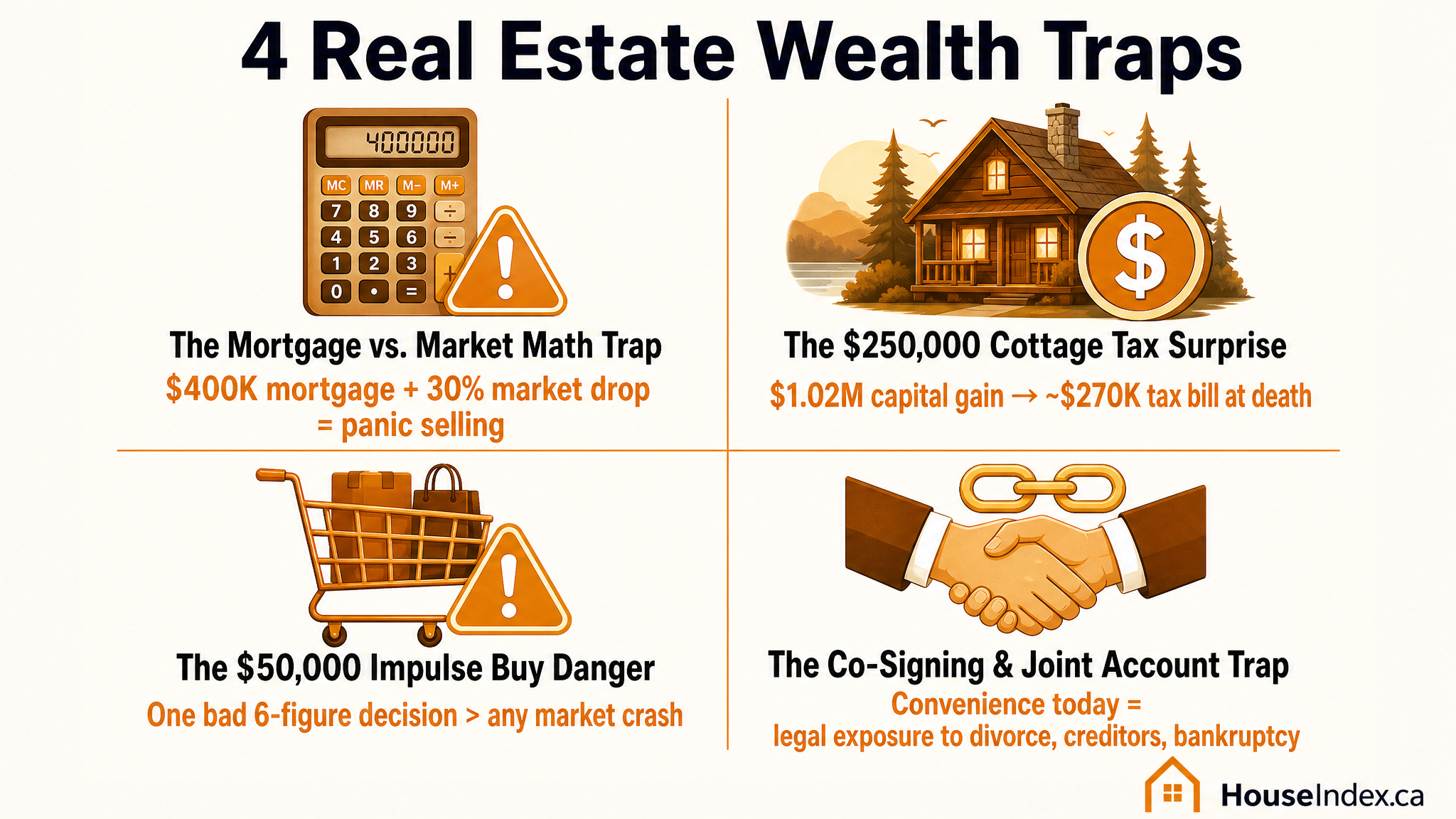
Infographic: 4 Canadian Real Estate Wealth Traps, the mortgage math trap, cottage tax surprise, impulse buy danger, and co-signing risk

The 4 Wealth Traps at a Glance

Trap #1

The Mortgage vs. Market Math Trap

7% returns mean nothing if you panic-sell in a crash while carrying a $400K mortgage

Trap #2

The $250,000 Cottage Tax Surprise

Deemed disposition at death triggers massive capital gains on a second property

Trap #3

The $50,000 Impulse Buy Danger

One emotional six-figure decision does more damage than any market crash

Trap #4

The Co-Signing & Joint Account Trap

Adding your kids to accounts for "convenience" exposes your wealth to their risks

Trap #1

The Mortgage vs. Market Math Trap

On paper, the math is seductive: if your mortgage rate is 4% and the stock market has historically returned around 7%, it makes "sense" to invest every spare dollar rather than pay down the mortgage early. You pocket the spread. Simple.

Here's what the spreadsheet doesn't model: your stress response in a downturn.

"Imagine you're carrying a $400,000 mortgage and your portfolio drops 30%. You're writing $2,800 monthly mortgage cheques while watching your investments bleed. The 'keep the mortgage' strategy requires a specific temperament, and most people discover they don't have it at the worst possible moment. A guaranteed savings rate that lets you sleep at night is worth more than an uncertain premium that keeps you up."

The families I work with across the GTA, from Mississauga, Vaughan, and Toronto , often own homes worth $1M–$2M+ with mortgages still in the six figures. When markets drop 30%, that emotional pressure is enormous. The panic sell at the bottom is the real cost, and no compound interest calculator accounts for it.

What to do instead

Before choosing between paying down your mortgage or investing, ask yourself: can I stomach writing that mortgage cheque if my portfolio drops 40% for 18 months? If the honest answer is no, the guaranteed return of paying down your 4–5% mortgage is the smarter wealth decision, not because of math, but because of behaviour. Consult a fee-only financial planner who can stress-test both scenarios against your actual income and risk profile.

Trap #2

The $250,000 Cottage Tax Surprise

This one blindsides families every year, especially in Ontario, where cottage country (Muskoka, Kawartha Lakes, Prince Edward County) has seen decades of steady appreciation.

Here's the scenario: the family cottage was purchased in 1998 for $180,000. Today it's worth $1.2 million. When the owner passes away, the CRA treats that cottage as if it were sold at fair market value, a "deemed disposition" under the Income Tax Act.

Running the numbers (2026 rules)

Fair market value at death$1,200,000
Adjusted cost base (purchase price)$180,000
Capital gain$1,020,000
Taxable portion (50% inclusion rate)$510,000
Estimated tax owing (at ~53% Ontario top marginal rate)~$270,000

* Based on 2026 federal + Ontario marginal rates. The 50% capital gains inclusion rate applies after the proposed 66.67% increase was permanently cancelled in March 2025. Capital improvements (new septic, structural additions, roofing) increase the adjusted cost base and reduce the taxable gain. Always confirm with a licensed CPA.

The Principal Residence Exemption can only be applied to one property per family unit per year, and for most families, it's used on the primary home, not the cottage. That means the cottage's entire gain is exposed.

"The kids want to keep the cottage, it's where they grew up, where they want to bring their own kids. But the tax bill is due, and the money to pay it has to come from somewhere. If there isn't enough liquid cash in the estate, the family might be forced to sell the cottage just to pay the CRA for the privilege of inheriting it."

What to do instead

  • Get a current appraisal of your cottage and calculate the projected deemed-disposition tax with a CPA. Knowing the number is step one.
  • Consider a joint-ownership or inter-vivos trust structure with an estate lawyer, it can spread the gain or defer it under specific conditions.
  • Fund the tax bill now with a life insurance policy equal to the estimated capital gains tax. The premium is a known, fixed cost; the alternative is a forced sale.
  • Document every capital improvement (new dock, septic, roof, additions), each one increases your adjusted cost base and reduces the eventual gain.

If you're already considering whether to upgrade your GTA home or hold and invest in a second property, the estate-tax math should be part of that decision before the offer is signed, not 30 years later.

Trap #3

The $50,000 Impulse Buy Danger

Market crashes get all the headlines. But in my experience working with buyers and sellers across the GTA, the single biggest threat to a family's wealth isn't a temporary market correction, it's a permanent, bad decision.

A vacation property bought on impulse during a trip. A renovation that spirals $200K over budget because "we're already committed." A rental property in another province bought at a seminar without checking local vacancy rates. These are the moves that permanently damage a balance sheet.

"Before you make any financial commitment over $50,000, run it through your plan, not your gut, not your excitement, not the pressure from the salesperson telling you 'this unit won't last.' Otherwise, you're making a six-figure bet on feelings."

The 2020–2022 era was especially costly for this trap. Record-low interest rates created a sense of urgency, and many GTA families stretched into second properties, pre-construction condos, or out-of-province investments without running the full carrying-cost math. When rates rose from 0.25% to 5%, those "affordable" payments doubled.

The $50K rule

Any real estate commitment over $50,000, a down payment, a renovation contract, an investment property deposit, gets a mandatory 72-hour pause. During those 72 hours:

  1. Run the full carrying cost (mortgage, property tax, insurance, maintenance, vacancy) against your actual cash flow, not projected rental income.
  2. Stress-test the payment at 2% higher than your current rate.
  3. Ask: would I still make this decision if I couldn't sell it for 5 years?

If you're actively looking, browsing current GTA listings with real data beats scrolling social-media "deals", you can compare prices, see days on market, and check what comparable properties actually sold for.

Trap #4

The Co-Signing & Joint Account Trap

This trap is driven by good intentions. A parent adds an adult child to a bank account or property title "for convenience", easier access to funds, a shortcut around Ontario probate fees (which run 1.5% on estates over $50,000). It seems harmless.

But in the eyes of the law, adding someone to an account or title creates a legal joint ownership interest. And that comes with consequences most families never consider.

"If your child goes through a divorce, that account is potentially part of the matrimonial asset pool. If your child has creditors, is sued, or goes bankrupt, that account is potentially exposed. You added them for convenience, but you've just given their spouse's lawyer, their creditors, or the bankruptcy trustee a legitimate claim against your money."

The same risk applies to co-signing a mortgage. I see this regularly in the GTA market: a parent co-signs to help a child qualify for a first home. The intention is generous. But if the child defaults, the parent's credit, assets, and even their own ability to refinance their home are at risk. And if the parent later wants to downsize to a condo or purchase a retirement property, that outstanding co-sign liability can prevent them from qualifying.

Safer alternatives

  • Use a Power of Attorney instead of adding children to accounts. It gives access without transferring ownership, and an estate lawyer can draft it with appropriate safeguards.
  • If co-signing is the only path to your child's first home, set a written plan (and ideally a legal agreement) for them to refinance in their own name within 2–3 years, then follow through.
  • Explore gifted-equity down payments, in some cases a parent can gift equity from their property toward the child's purchase without co-signing the debt. Ask your mortgage broker about the specifics.

If your family is navigating a first-time purchase or a "how much can I afford?" conversation, get the legal structure right at the start, not after a family dispute or financial emergency forces the issue.

The Bottom Line

None of these traps are caused by a bad market. They're caused by making major financial decisions without a plan, or with a plan that doesn't account for Canadian tax rules, estate law, and the emotional reality of carrying real estate debt through volatile markets.

The fix is straightforward: before your next real estate move, whether that's buying, selling, refinancing, or transferring property to family, sit down with three people: your realtor (to understand the market), a CPA (to run the tax numbers), and an estate lawyer (to structure things properly). The cost of that planning session is a rounding error compared to any one of these traps.

Planning Your Next Real Estate Move?

Whether you're thinking about buying, selling, downsizing, or sorting out a family property situation in the GTA, let's start with a conversation. No pressure, no obligations.

Related Articles